Linea Skater
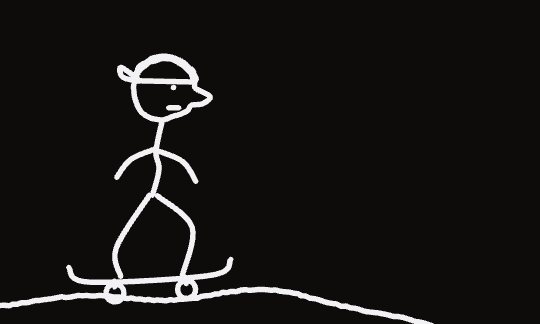
Skate an endless ink line, ollie the gaps, grind the rails and catch trick tokens.
- Developer
- GAMEFREEX
- Released
- Updated
- Game engine
- HTML5
- Platforms
- Browser (desktop, mobile, tablet), installable app (PWA)
- Orientation
- Portrait
- Controls
- Keyboard, Mouse, Touch, Controller
- Multiplayer
- Yes, with friends: score race, up to 4 players
- Offline play
- Yes, once opened or saved with Download games for offline
- Price
- Free, no download, no sign-up
- Sport4
- Portrait53
- Keyboard54
- Mouse57
- Multiplayer53
Controls
Computer
- SPACE or Arrow Up to ollie
- Click to ollie
Phone or tablet
- Tap to ollie
Controller
- A or Up: ollie
- Start: pause
Linea Skater: how to play, tips and FAQ
Written by the GAMEFREEX team.
The whole course is a single ink line, and it bends into ramps, springs, rails, loops, gaps and chasms as you ride. Your skater rolls on their own. You ollie, and you aim your jumps through floating trick tokens: the token decides which trick you do.
There is no last level. A level is six sections, about 16 seconds of riding, and each one is a little faster than the last: about 10 percent faster by level 10 and 37 percent by level 50. The first five levels are the easy ones, with smaller obstacles spaced further apart. New pieces show up as you go: gaps at level 2, springs at 3, speed pads at 4, rails at 5, chasms at 8, then set pieces such as a ramp over a chasm (level 10), a rail across a chasm (12), a row of evenly spaced obstacles (15) and two gaps in a row (25). The palette changes every five levels.
Before a section appears, the game rides it with the real jump physics and throws it away if it cannot be cleared with a fair margin of timing. Tricks are worth 60 points for an Ollie up to 320 for a Frontflip, and every token raises your combo by one, up to x9. You have three lives.
- Timing
- Rhythm
At a glance
- Levels
- Endless, 6 sections each
- Game ends
- When the 3rd life is lost
- Trick tokens
- 11 tricks, 60 to 320 points
- Level bonus
- 50 x the level reached
- Combo window
- About 3 s of real time
How to play Linea Skater
- Ollie with Space, the Up arrow or a click, or tap the screen.
- Jump through trick tokens to perform tricks.
- Land on a rail to grind it, and jump off or roll off the end.
- Collect stars and clear the gaps.
Controls, action by action
| Action | Computer | Phone or tablet |
|---|---|---|
| Ollie | Space, Up arrow or a click | Tap the screen |
| Trick | Fly through a token | Fly through a token |
| Grind | Land on a rail | Land on a rail |
| Ramp or spring launch | Automatic when you roll over it | Automatic when you roll over it |
How the levels are built
A level is six sections of about 2.7 seconds each. Speed goes up slowly with the level: about 10 percent faster than level 1 at level 10, 37 percent at level 50, and close to 50 percent around level 100. Levels 1 to 5 are the gentle part: obstacles are up to 20 percent smaller, there are fewer of them, and the gaps are shorter and further apart. Every 5 levels the colors switch to a new theme (Dusk, Concrete, Neon, Night, Heat, Storm, Acid), and you get 50 points times the new level each time you reach one.
Pieces unlock as you climb. Cones, crates, mounds and ramps from the start; gaps, bushes, spikes and loops at level 2; rocks and springs at 3; fences and speed pads at 4; rails at 5; chasms and pairs of obstacles you clear in one jump at 8. After that come set pieces: a ramp or spring right before a chasm (level 10), a rail across a chasm (12), three or four obstacles at an even rhythm (15), a spring that throws you onto a rail (20) and two gaps in a row (25).
Each section comes from the course seed and its own number, and the game rides it with the real physics before you see it. A section is kept only if it can be entered on the ground and left on the ground, with a window of timing for every jump rather than one exact frame. If a draw fails, the game draws again with more space. The same seed always gives the same sections, so a score race is fair.
Jumping, landing and grinding
A tap up to about 0.13 seconds before you land is kept and fires the moment the wheels touch, and you can still ollie for about 0.1 seconds after rolling off an edge. The game runs at a fixed 120 steps per second, so the jumps are the same on a 30 Hz and a 144 Hz screen, and a fast skater cannot pass through a thin obstacle between two frames.
Obstacles are small enough that a plain ollie clears the tallest one, the fence, with room to spare. Their hitboxes follow the drawings (a cone is a triangle, a fence includes its rails) but are 20 percent lower and 15 percent narrower than the art, and a landing that just catches the far lip of a gap still counts. The game times every trick so the rotation ends before you touch down. A landing that is a bit off shows SKETCHY and costs nothing; only a landing that is clearly wrong throws you off the board.
Land on a rail from above to grind it: 90 points times your combo, the combo goes up by one as with a token, and distance points count double while you grind. Hitting the end or the side of a rail is a crash. You can ollie off a rail or roll off its end.
Speed pads, crashes and the adjustment
From level 4, about 3 sections in 10 end with a speed pad, placed after the last obstacle of the section. The X2 pad floats a little above the line and doubles your speed; the SLOW pad sticks to the line and halves it, so ollie over it. Either effect stops at the end of the section, which is why a pad can never make a jump impossible. Roughly 1 pad in 3 is an X2.
Hitting an obstacle throws you off the board, and you get up where you fell, or a little earlier if the spot would not leave room to clear what is ahead. Falling into a gap puts you back before the edge, at a point the game has checked.
In normal play the course adjusts to you a little. After a crash or a fall, the next sections are up to 7 percent slower, with more room between pieces and gaps up to 12 percent shorter; starting a new run eases them a bit too. Clean sections in a row push the other way, to about 4 percent faster than the level curve. In a score race nothing adjusts: every player gets the same course.
Tips to score higher
- You can tap a moment before you land: the jump goes off as soon as the wheels touch. That is how you clear the evenly spaced rows from level 15.
- Rails pay 90 points times your combo when you land on them, raise the combo like a token, and give double distance points while you grind.
- Ramps and springs launch you on their own. From level 10 some of them sit right before a chasm that a plain ollie cannot cross, so let them throw you.
Common mistakes
- Waiting to see the ground before tapping on a fast level. Tap just before you land, the jump is kept and fires on contact.
- Ollieing for style in front of a ramp or spring. They launch you on their own, and landing on top of one can throw you somewhere you did not plan.
- Taking off early before a chasm. Chasms are up to about 80 percent of a jump length wide, so leave from the edge.
- Rolling into the side of a rail. Either jump high enough to land on top, or clear it completely.
- Expecting to jump inside a loop. The game ignores the input there, so be ready the moment you come out.
Linea Skater FAQ
Does the game get easier if I keep crashing?+
A little. After a crash the next sections are up to 7 percent slower, with more room between obstacles and shorter gaps, and a run of clean sections tightens them again. In a score race everyone gets the same course, with no adjustment.
Why is the course different every time?+
Each visit generates a new course with its own terrain, speed, colors and music. The sections themselves are built from that course's seed, so the same seed always gives the same levels.