Nation Simulation: how to play, tips and FAQ
Free simulation game · No download · Phone, tablet and computer
Written by Xavier Eric Francois Guiter, who designed and built this game. Updated .
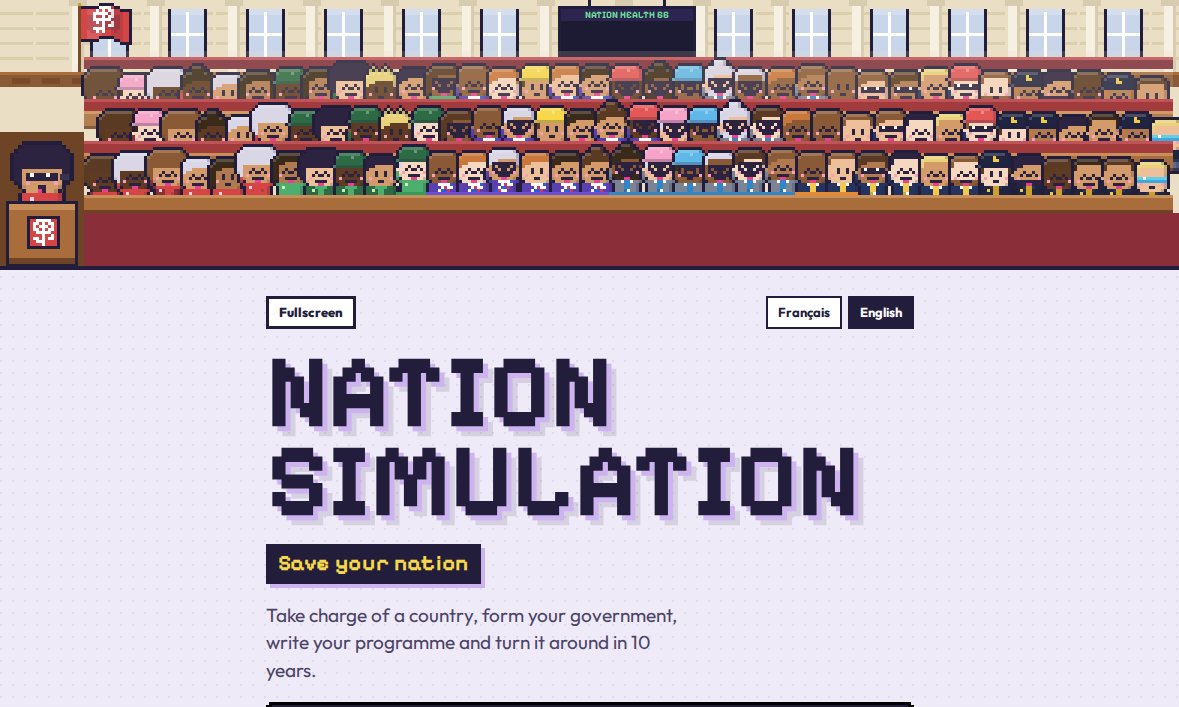
Nation Simulation hands you one of 195 countries for ten years. Each one starts from its own figures: growth, unemployment, inflation, deficit, debt, crime and liberties, rounded from 2025-2026 data. You name the head of government, choose one of six political families and write a programme of promises before the first quarter begins.
A term is 40 quarters. Every quarter you can move each ministry's budget by one notch and spend political capital to propose laws, many of them based on reforms that other countries really tried. Then events land on your desk, from a general strike to an oil shock, and each one asks for a choice. A recovery index sums it all up: 50 means the country is where it started, and the higher you push it, the better your final grade.
- Planning
- Economics basics
- Decision making
At a glance
- Term
- 40 quarters, 10 years
- Laws
- 47, costing 2 to 10 capital
- Random events
- 26, about 1 quarter in 3
- Parliament
- 300-seat Assembly, 100-seat Senate
- Promises
- Up to 20
- Freex Coins
- 5 per year, half the final score
How to play Nation Simulation
- Pick a country on the map or search for it. The colour modes show difficulty, debt or security, and View the plan lists what the country needs first.
- Choose a political family. Each one makes some ministries more effective and others less, and the National Coalition earns 1 extra point of political capital every quarter.
- Tick the laws you promise. Promised laws get more votes in Parliament, and every promise kept helps at the mid-term election.
- Each quarter, adjust the nine ministry budgets with - and +, propose laws with your political capital, then press Quarter to move on. The play button runs time on its own at speed x1, x2 or x4.
- Answer each event by picking one of its options. The term ends after 40 quarters, or earlier if you lose the mid-term election, a no-confidence vote or the trust of your creditors.
Controls
| Action | Computer | Phone or tablet |
|---|---|---|
| Pick a country | Click it, or search and press Enter | Tap it, or search |
| Set a ministry budget | Click - or + | Tap - or + |
| Propose a law | Click the law, then choose the route | Tap the law, then the route |
| Next quarter | Quarter button | Quarter button at the bottom |
| Run time on its own | Play button, speed button for x1, x2, x4 | Same buttons |
| Close a window | Escape or click outside it | Tap outside it |
Three ways to pass a law
A Parliament vote costs the law's price in political capital, half refunded if the Assembly says no. The emergency procedure costs 4 more, skips the Assembly vote and costs 2 points of middle-class support, but for the next 3 quarters it adds 25 points to the chance of a no-confidence motion. A referendum costs 2 more and passes above 50% yes: a win adds 3 points of working-class and 2 of middle-class support, a defeat takes 3 from each.
The Senate votes after the Assembly. If it says no, the law still passes, 2 quarters late. Your party starts with 31% of the Assembly and 1 ally with 13%, or 25% and 2 allies at 10% for the National Coalition. Promised laws get a few extra votes, and a law takes 4 to 32 quarters to reach full effect.
Budgets, popularity and capital
Each ministry budget runs from -2 to +2, one notch per quarter, each notch worth 0.3% of GDP of spending. On the Finance line it is taxes, 0.4% of GDP of revenue. Their effects shrink as the indicator they push gets close to 0 or 100. A tax notch up costs 2 points of middle-class and 1 of working-class support but adds 2 to market trust.
Popularity is 55% working class and 45% middle class. Its target gets +8 in the first quarter, fading by 2 per quarter, and loses 0.15 per quarter for the whole term. Political capital refills by 2 per quarter, plus 1 for the National Coalition, plus 1 for every 20 points of popularity above 50 (and minus below). It starts at 12, or 13 for the Order Bloc and 14 for the Efficiency Party.
Early endings and the final grade
At quarter 20, kept promises move both classes by (share kept minus 0.4) x 12 points: +7.2 if you kept them all, -4.8 if none. Then you need 45% support, 42% for the National Coalition. Below 28% support a no-confidence motion is tabled more and more often, below 16% every quarter, and it passes with 151 votes. If market trust drops under 5 while debt is high, the first time brings an IMF plan, the second a default. Liberties under 12, and 20 points below their start, also end it.
The recovery index weighs growth (last 8 quarters) and debt 14% each, unemployment and security 12%, inflation (distance to 2%) and liberties 10%, education and health 8%, integrity and popularity 6%.
Tips to score higher
- The first year is the honeymoon: unpopular reforms cost less popularity then than later.
- Political capital caps at 30 and refills a little every quarter. Do not sit on a full bar.
- Watch popularity before quarter 20: the mid-term election ends the game if you are too far behind.
- A first debt crisis brings an emergency IMF plan. A second one means default and the end of your term.
- Liberties count. Pushing them very low ends the game as an authoritarian drift, even if the economy looks fine.
Common mistakes
- Starting slow laws late. A reform that needs 32 quarters, proposed in year 5, never reaches full effect.
- Using the emergency procedure repeatedly. Each use keeps the no-confidence risk high for 3 quarters.
- Raising spending while debt is above the country's tolerance. Each notch then costs 1.5 times as much market trust, which pushes up interest rates.
- Promising more than you can pass. Each undone promise lowers the mid-term result.
Nation Simulation FAQ
How is the score calculated?+
The score is the recovery index at the end of the term, from 0 to 100. It compares growth, jobs, prices, public finances, security, liberties and the other indicators with where the country started. 85 and above earns an S grade, 72 an A, 60 a B and 48 a C.
Which games go on the leaderboard?+
Only completed ten-year terms. If your government falls early, the game ends without a score. You also get 5 Freex Coins for each full year in office and a bonus at the end of a term.
Is this real politics?+
No. Countries start from rounded real figures and the laws are inspired by reforms tried around the world, but the parties, leaders and events are fictional. The model is simplified so that one quarter plays in a few seconds.
Can I play in French?+
Yes. The title screen has a Français and English switch, and your game is saved on this device so you can come back to it.