Atom Freex
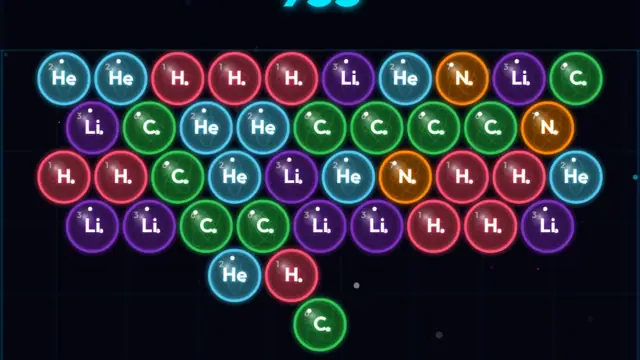
Match-3 with real atoms: line up H, He, Li, C, N and O to set off reactions.
- Developer
- GAMEFREEX
- Released
- Updated
- Game engine
- HTML5
- Platforms
- Browser (desktop, mobile, tablet), installable app (PWA)
- Orientation
- Portrait
- Controls
- Mouse, Touch, Controller
- Multiplayer
- Yes, with friends: score race, up to 4 players
- Offline play
- Yes, once opened or saved with Download games for offline
- Price
- Free, no download, no sign-up
- Puzzle16
- Portrait53
- Mouse57
- Multiplayer53
Controls
Computer
- Click atom then click adjacent
- Drag atoms to swap
Phone or tablet
- Tap atom then tap adjacent
- Swipe atoms to swap
Controller
- Left stick or D-pad: move the cursor
- A on a piece, then A on a neighbor: swap
- Or hold A, press the D-pad once, let go
- Start: pause
Atom Freex: how to play, tips and FAQ
Written by the GAMEFREEX team.
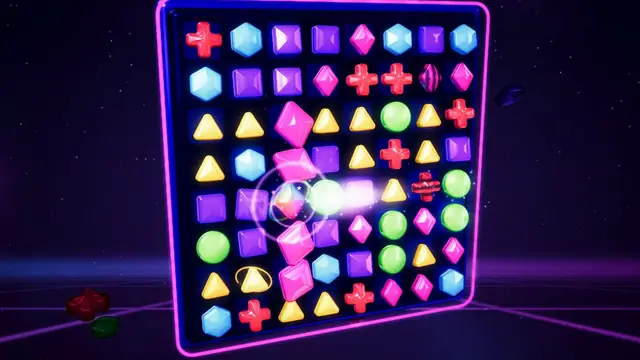
Hydrogen, helium, lithium, carbon, nitrogen and oxygen fill an 8 by 8 board, each atom drawn with its symbol and atomic number. Atom Freex plays like classic match-3: swap two neighbors to line up three of the same element and they react and vanish.
The part to understand early is the clock. You get 60 seconds for the whole run, and it never refills between levels. Each level also has a move budget (30 moves on levels 1 and 2, 25 on levels 3 to 5, then 20) and a target that grows by 300 points per level, starting at 800. Hitting the target does not end the level: you keep playing your remaining moves, then a new board starts the following level. In practice the clock ends most runs, so speed matters more than the move counter suggests.
Only five elements appear until level 6, when the sixth joins and matches get harder to find. Chains announce themselves: three reactions in a row is an Isotope, four a Chain Reaction, five or more a Nuclear Fusion.
- Pattern recognition
- Quick decisions
- Element symbols
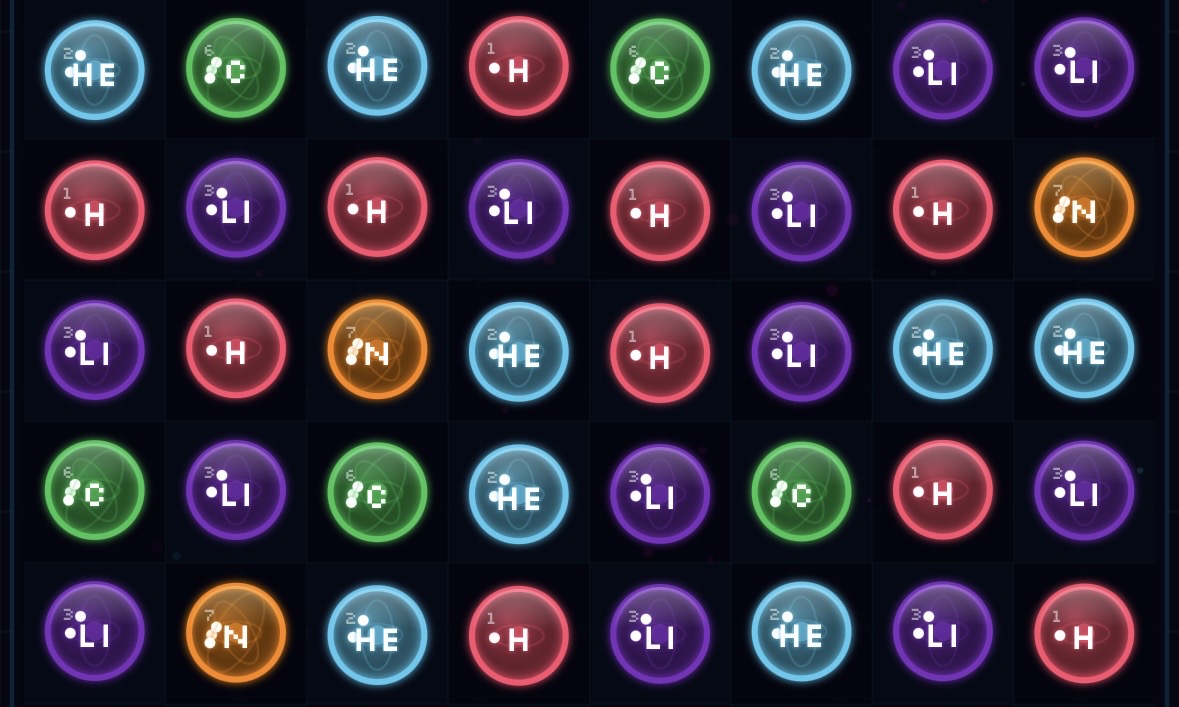
At a glance
- Board
- 8 by 8 atoms
- Game ends
- Clock at 0, or moves out below target
- Clock
- 60 s for the whole run
- Moves per level
- 30, then 25, then 20
- Best cascade multiplier
- x8 per atom
- Elements
- 5, then 6 from level 6
How to play Atom Freex
- Click an atom and then a neighbor, or drag one atom onto the next. On a phone, tap two neighbors or swipe.
- A swap only counts if it makes a line of three or more identical atoms.
- Watch the timer bar at the top: when it empties, the run is over, whatever level you are on.
Controls, action by action
| Action | Computer | Phone or tablet |
|---|---|---|
| Swap two atoms | Click an atom, then a neighbor, or drag one onto the next | Tap two neighbors, or swipe from one toward the next |
| Cancel a selection | Click the selected atom again | Tap the selected atom again |
| Pause or restart | Buttons in the top bar | Buttons in the top bar |
How points are counted
Every atom removed in a reaction is worth 20 points times the cascade step, so a plain line of 3 gives 60. When falling atoms form a new line on their own, that reaction is step 2 and each atom is worth 40, then 60 at step 3, and so on up to 160 per atom from step 8. Each reactor caught in a reaction adds 30 more.
The step counter starts again with every swap, so cascades only build inside one move, and a swap that runs to step 5 pays far more per atom than five separate small matches.
The Radioactive Bomb is the exception. Swapping it with a neighbor removes every atom of that neighbor's element for a flat 250 points and uses one move. Any cascade that follows is scored normally.
What each reactor does
A line of 4 leaves a Line Reactor on one of its middle atoms, and the line it clears runs across the match: 4 side by side make a reactor that clears its column, 4 stacked vertically make one that clears its row. An L or T shape puts a Lightning Reactor on the cell where the two lines meet, which clears its whole row and column. A line of 5 makes a Radioactive Bomb.
Reactors keep the element of the atom they replace. A Line or Lightning Reactor only fires when it is part of a later match of its own element; swapping it alone does nothing special. A Radioactive Bomb also fires when matched in a line, and then removes every atom of its own element. Reactors hit by another reactor's blast fire too, so one swap can set off several in a row.
Levels, moves and the clock
Targets are counted from your score when the level begins: 800 for level 1, then 1,100 more for level 2 and 1,400 more for level 3, adding 300 each time. Each new level starts on a fresh random board, built so that no line of 3 is already in place. The moves counter, labeled BONDS, blinks red from 5 moves left, and the clock bar turns red in the last 10 seconds.
A swap that makes no match slides back and costs no move, but the clock keeps running through it, and through every cascade: each step spends about 0.6 seconds on animation. If your moves run out before the target, the run ends there, even with time left.
Tips to score higher
- Do not sit on a move hunting for the perfect combo. Sixty seconds goes fast, and a quick small match is worth more than a big one you never get to play.
- Four in a row makes a line clearer, an L or T shape clears a full row and column, and five in a row makes a radioactive bomb that removes every atom of one element when swapped.
- Matches near the bottom shuffle more of the board and set off free cascades.
Common mistakes
- Swapping a Line or Lightning Reactor and expecting it to fire. Only the Radioactive Bomb reacts to a swap on its own; the others need to be part of a match.
- Spending a Radioactive Bomb on a rare element. It pays 250 whatever it removes, so pick the element that covers the most of the board: more empty cells means more falling atoms and more free cascades.
- Testing swaps to see which ones work. A failed swap costs no move, but it takes almost half a second of a clock that never refills.
Atom Freex FAQ
I reached the target score. Why am I still on the same level?+
The level only ends when your moves run out. Every move after the target adds to your score, so use them quickly before the clock gets you.
Will I learn anything about chemistry?+
A little: you will know the symbols and atomic numbers of six light elements by heart. The game itself is classic match-3.