Chemistry Freex
A periodic table quiz: find elements by name, symbol or atomic number.
- Developer
- GAMEFREEX
- Released
- Updated
- Game engine
- HTML5
- Platforms
- Browser (desktop, mobile, tablet), installable app (PWA)
- Orientation
- Portrait
- Controls
- Mouse, Touch, Controller
- Multiplayer
- Yes, with friends: score race, up to 4 players
- Offline play
- Yes, once opened or saved with Download games for offline
- Price
- Free, no download, no sign-up
- Education2
- Portrait53
- Mouse57
- Multiplayer53
Controls
Computer
- Click the correct element on the grid
- Read the explanation after each answer
Phone or tablet
- Tap the correct element
Controller
- Left stick or D-pad: move the cursor
- A: pick the element
- Start: pause
Chemistry Freex: how to play, tips and FAQ
Written by the GAMEFREEX team.
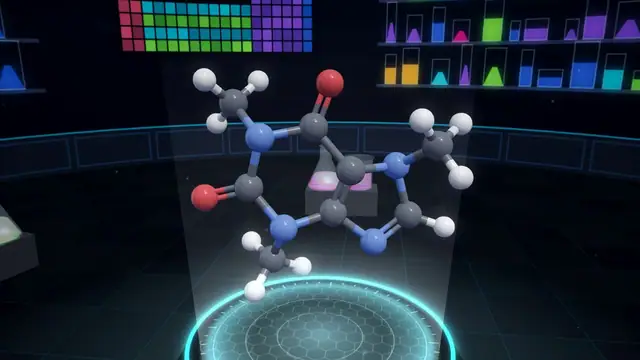
A grid of element cards, each with its symbol, name and atomic number, colored by family. A question appears, and you tap the card that answers it. Chemistry Freex asks three kinds: find an element by name, find the element a symbol belongs to, or find the element with a given atomic number.
The board starts with 14 cards and gains 2 per level, up to 28. Each level is 8 questions. You get 14.5 seconds per question on level 1 and half a second less each level after, down to a floor of 10 seconds from level 10. A correct answer is worth 100 points, plus a speed bonus, plus 20 for every answer in your current streak. Wrong answers and timeouts cost one of three lives, and every answer comes with a short explanation and a fact.
The deck holds 55 cards: 44 elements, 6 alloys (bronze, brass, electrum and others) and 5 compounds such as water and salt. Alloys and compounds have no atomic number, so they only come up in name and symbol questions.
- Periodic table knowledge
- Quick recall
At a glance
- Game ends
- When all 3 lives are gone
- Questions per level
- 8, right or wrong
- Answer time
- 14.5 s, down to 10 s
- Cards on the board
- 14, up to 28 on level 8
- Card families
- 11 colors
- Saves progress
- No, every run starts at level 1
How to play Chemistry Freex
- Read the question at the top.
- Tap or click the matching card before the timer runs out.
- Read the explanation, then move on to the next question.
Controls, action by action
| Action | Computer | Phone or tablet |
|---|---|---|
| Answer | Click a card | Tap a card |
| See a card's family | Hover the card for its name and family | Not available, read the colored bar on the card |
| Close the fact card early | Click anywhere over the grid | Tap anywhere over the grid |
| Pause | Pause button in the top bar | Pause button in the top bar |
Every answer is printed on the board
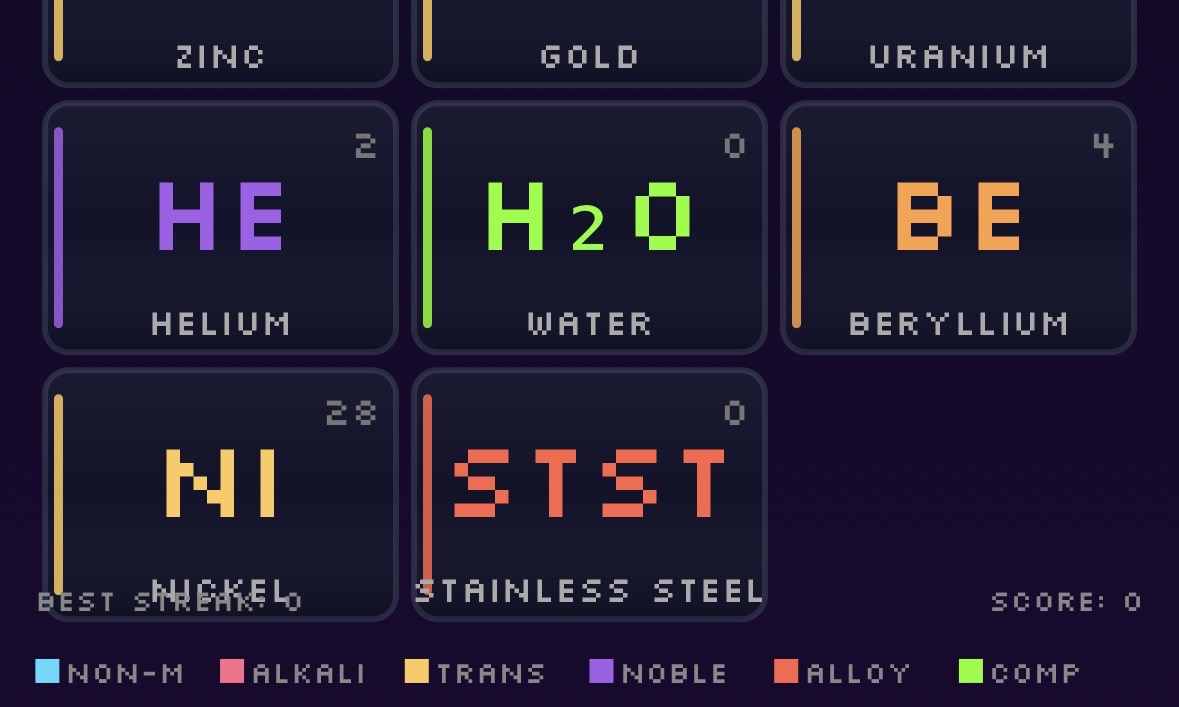
Each card shows three things: the symbol in large letters, the name in small text underneath, and the atomic number in small grey digits in the top right corner. So the answer is always visible. The quiz is about knowing where to look first.
The large symbols are the fastest thing to scan. For a name question, turn the name into its symbol in your head (Tin is Sn, Mercury is Hg) and look for the big letters. For a number question, do the same: 53 is iodine, so look for I instead of reading every small grey number.
The thin bar on the left edge of each card gives the family: pink for alkali metals, orange for alkaline earth metals, yellow for transition metals, silver grey for post-transition metals (aluminium, gallium, tin, lead and bismuth), brown for uranium, the only actinide, light blue for non-metals, teal for halogens, purple for noble gases, mint green for metalloids, red for alloys and lime green for compounds. The legend at the bottom only lists six of them; hover a card on a computer to see its family by name.
Alloys have no chemical symbol, so their cards show a plain label instead: Bronze, Brass, Electrum, Duralumin, Stainless for stainless steel and Li alloy for the aluminium-lithium alloy used in aircraft. They only ever come up as Find questions. Compounds show their real formula, such as H₂O or NaCl, and can be asked by formula.
Points, timer and levels in numbers
A correct answer scores 100, plus a speed bonus that starts at 87 on level 1 and shrinks as the bar empties, plus 20 for every answer already in your streak. The first answer of a streak adds nothing, the 6th adds 100, the 10th adds 180, and there is no cap. From the 6th answer in a row, the streak is worth more than the best possible speed bonus.
A level is 8 questions, and misses and timeouts count toward the 8 like correct answers. The board is dealt once per level: all 8 questions use the same cards, and the same card can be the target twice. Each question picks its target at random among the cards on the board. A new level reshuffles the board from the 55-card deck and adds 2 cards.
The timer loses half a second per level, from 14.5 seconds on level 1 to 10 seconds from level 10. It stops while the fact card or the correct answer highlight is on screen, so reading the fact costs you no time. After a miss, the right card glows gold for 1.5 seconds and taps are ignored until it fades.
Tips to score higher
- Learn the symbols that do not match English names: Na is sodium, K potassium, Fe iron, Au gold, Ag silver, Pb lead.
- Use the family colors to narrow the search. Noble gases and halogens each have their own color. Post-transition metals such as aluminium, tin and lead have their own silver-grey color, and uranium, an actinide, has a brown one.
- For number questions, keep a few anchors in mind: carbon 6, oxygen 8, iron 26, gold 79.
Common mistakes
- Reading the small text on every card. For name and number questions alike (26 is Fe, 80 is Hg), turn the answer into a symbol and scan the large letters.
- Expecting a new board after each question. The cards stay in place for all 8 questions of a level, so learn where things sit during the first few.
- Skipping over alloys and compounds. The bronze card is as likely to be the target as the iron card, so give them the same attention when you scan the board.
Chemistry Freex FAQ
Why are there cards for water and bronze?+
The deck mixes in a few compounds and alloys to keep you reading the cards. They are never the answer to an atomic number question.
Does the streak bonus reset on a timeout?+
Yes. A timeout counts like a wrong answer: you lose a life and your streak.