Number Freex
Pick the right answer out of four before the timer empties.
- Developer
- GAMEFREEX
- Released
- Updated
- Game engine
- HTML5
- Platforms
- Browser (desktop, mobile, tablet), installable app (PWA)
- Orientation
- Portrait
- Controls
- Mouse, Touch, Controller
- Multiplayer
- Yes, with friends: score race, up to 4 players
- Offline play
- Yes, once opened or saved with Download games for offline
- Price
- Free, no download, no sign-up
- Math1
- Portrait53
- Mouse57
- Multiplayer53
Controls
Computer
- Click the correct answer
Phone or tablet
- Tap the correct answer
Controller
- LB and RB: top left and top right answers
- LT and RT: bottom left and bottom right answers
- Or left stick to point and A to tap
- Start: pause
Number Freex: how to play, tips and FAQ
Written by the GAMEFREEX team.
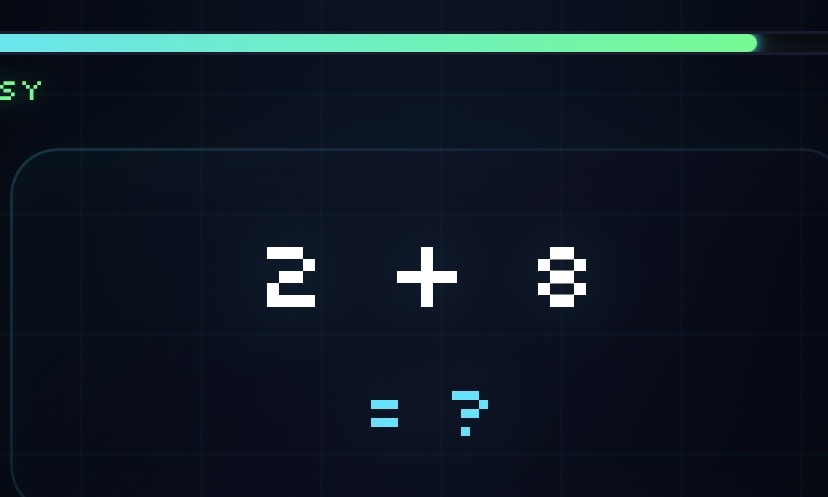
A sum, four answers, a countdown. Number Freex changes what kind of math it asks as you go, so it helps to know the stages. Questions 1 to 5 are Easy: additions with numbers up to 10. Questions 6 to 12 are Normal: additions and subtractions with numbers up to 20. Questions 13 to 22 are Hard, and Hard is nothing but times tables from 1 to 12. Expert, up to question 35, mixes all four operations including division. After that comes Insane, with bigger numbers that keep growing.
Time per question starts at 8 seconds and loses 0.8 seconds per stage, down to 2.5. Answers are worth 100 points plus 25 per stage. Five correct in a row doubles your points, then x3 at 10, x4 at 15 and x5 at 20. Answer in the first 30 percent of the time and that answer is worth 1.5 times more. A wrong answer or a timeout costs one of three hearts and resets the streak.
- Mental arithmetic
- Estimation
At a glance
- Game ends
- After 3 misses or timeouts
- Lives
- 3 hearts
- Answer time
- 8 s, down to 2.5 s
- Stages
- Easy, Normal, Hard, Expert, Insane
- Best multiplier
- x5 after 20 in a row
How to play Number Freex
- Read the question in the middle of the screen.
- Click or tap the right answer among the four options before the bar empties.
- Three mistakes or timeouts end the game.
Controls, action by action
| Action | Computer | Phone or tablet |
|---|---|---|
| Answer | Click one of the four options | Tap one of the four options |
| Pause | Pause button in the top bar | Pause button in the top bar |
What each stage asks
Easy only adds two numbers from 1 to 10, so the largest answer is 20. Normal mixes additions up to 20 + 20 with subtractions that always stay positive. Hard is a pure times-table drill, every factor between 1 and 12.
Expert draws one of the four operations at random. Additions and subtractions use numbers up to 30, multiplications go from 2 x 2 to 13 x 13, and every division is built backwards from a multiplication, so its answer is a whole number between 1 and 10.
Insane starts at question 35 and grows every 15 questions after that. Numbers get bigger each time, multiplication and division become more frequent, and about one subtraction in three takes a larger number from a smaller one, so the answer is negative.
How the wrong answers are chosen
The three wrong options are not random. About a third of them sit 1 to 3 away from the right answer, and others are 4 to 8 away. In a multiplication, one decoy is often the answer plus one of the two factors, the classic slip of adding one row too many. In an addition, a decoy can be the difference of the two numbers instead of the sum.
Knowing this helps. When two options are very close, check the last digit or the parity: an even number times anything is even, and the sum of two odd numbers is even. That usually leaves one candidate.
Where the points come from
A correct answer is worth 100 points plus 25 per stage, so 125 on Easy and 200 on Expert. The streak multiplier then doubles it from 5 correct answers in a row, triples it from 10, and reaches x5 at 20. Answering within the first 30 percent of the timer adds another x1.5.
Put together, a fast answer on Expert with a streak of 20 is worth 1,500 points, twelve times an Easy answer. A long clean streak matters far more than speed on any single question.
Tips to score higher
- Check the last digit first. 7 x 8 must end in 6, which usually rules out two or three options at once.
- If times tables are not automatic for you, the Hard stage will cost hearts. It is ten questions of pure multiplication.
- Estimate before you calculate. Often only one option is in the right range.
- A streak at x4 is worth more than a rushed answer. When unsure, take the extra second.
Common mistakes
- Rushing every answer for the speed bonus. A miss costs a heart and resets the multiplier, which is worth more than the x1.5 from speed.
- Forgetting that timeouts count. A question you let run out still moves you toward the next stage, so stalling does not keep the game easy.
- Reading the minus sign too late in Insane. Some answers are negative; check which number is larger before you look at the options.
- Doing the full multiplication when the last digit is enough to rule out three options.
Number Freex FAQ
Does a timeout still move me forward?+
Yes. Timed-out questions count toward the stage progress, so the game keeps getting harder even when you miss.
Are division answers always whole numbers?+
Yes. Division questions are built from a multiplication, so the answer is always a whole number.
Was that answer negative?+
Possibly. In the Insane stage, some subtractions take a bigger number from a smaller one, so the right answer is below zero.