Spiral Tower: When the Virus Catches Up, and What Each Power Buys You
The climbing speeds in Spiral Tower, the minute a clean run lasts without powers, how far apart obstacles and orbs sit, what the five powers are worth in steps, and how a race gives everyone the same tower.
Two speeds
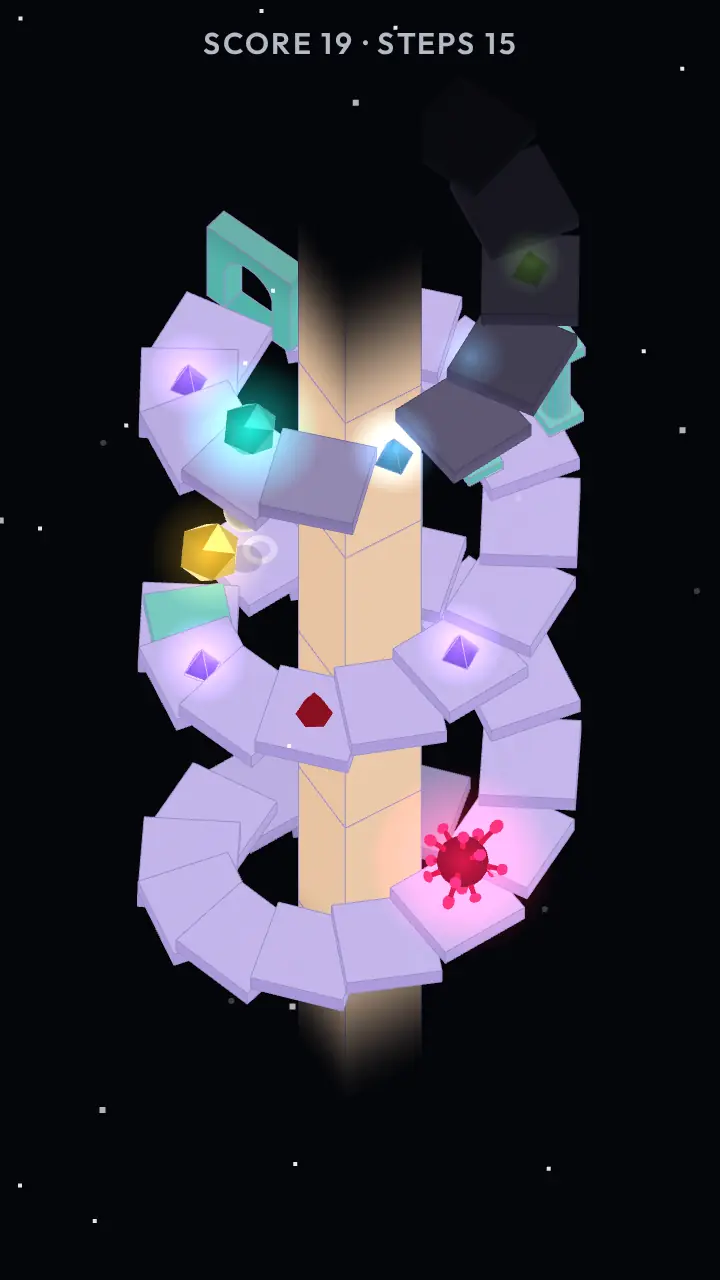
In Spiral Tower the glass sphere climbs 3.2 steps a second and never slows down on its own. The spiky red virus starts 5 steps behind it at 2.7 steps a second, and gains 0.022 steps a second for every second of the run. Nothing else in the game changes speed.
Those three numbers decide how a run goes. For the first 23 seconds you are faster, and the gap grows to about 10.7 steps. After that the virus is faster and the gap shrinks. With every jump on time and no power at all, it reaches you about 54 seconds in, near step 170. Every longer run is made of powers.
The score line shows a warning sign once the virus is less than 4 steps behind. At that point, on a plain stretch, you have a second or two.
What stops you
Three kinds of obstacle sit on the steps, at equal odds: a missing step, red spikes and a floating ghost. They behave the same way: roll into one and the sphere stops dead until you jump, while the virus keeps climbing. Every second stopped, the virus closes in by its full speed, 2.7 steps a second at first and close to 4 by the 50th second, when the gap is often down to two or three steps. Late in a run, one late tap ends it.
A new obstacle comes every 4 to 9 steps, and the first one sits 12 to 17 steps from the start. Left alone, the sphere stops at that first one and the virus catches it within a few seconds.
A jump lasts half a second, which carries the sphere about a step and a half. Tap when the obstacle is one step ahead. Tapping two steps early lands you on it, and a second tap in the air does nothing. Only a short tap jumps: a drag turns the camera instead. Space, the Up arrow and W jump on a keyboard, and A, B or X on a controller.
Pyramidions and power orbs
Small colored pyramidions sit every 2 to 5 steps and are picked up as you roll past, 1 point each. Power orbs float over a step every 12 to 22 steps, about one every 5 seconds at full speed. Each one is worth 5 points and gives one of five powers for 6 seconds, all five at equal odds:
- Boost makes the sphere 1.7 times faster. Over its 6 seconds that is about 13 extra steps of lead.
- Slow enemy drops the virus to 35 percent of its speed. Half a minute in, that is worth about 13 steps too, and more later, since the virus is faster by then.
- Shield waits for the virus. If it touches you during those 6 seconds, it is knocked 7 steps back and stunned for a moment, and the shield is used up.
- Gap filler lets the sphere roll straight across holes, spikes and ghosts. It gains no lead by itself, but it removes every chance of a late tap for 6 seconds.
- Magnet collects every pyramidion within 4 steps. Points, no lead.
Boost and Slow enemy are the two that make a run last. An automated test player that jumped every obstacle on time climbed 442 steps in 128 seconds. Without powers the virus arrives by the 54th second, so all of that extra time came from the orbs it collected. Do not skip an orb to play safe: the next one is 12 steps away at best.
Score and coins
The score is one point per step climbed, plus one per pyramidion and five per power orb. In the test run above, steps made up 442 of the 692 points. Freex Coins (a virtual currency with no monetary value) come from that score at the end of the run, plus one per pyramidion. Once per run you can watch a short ad to continue: the virus is put back 10 steps behind you and held still for a second and a half.
A new tower every visit, the same tower in a race
Each visit builds a new staircase from a random seed: a radius, a slope of 0.5 to 0.64 per step, a full turn every 13 to 18 steps, turning left or right, and its own pastel colors. Within one visit the staircase stays the same, and each replay lays out new obstacles and orbs on it.
In a score race, every player of the round gets the room's seed instead. Everyone climbs the same staircase and meets the same obstacles, pyramidions and orbs at the same steps from the start, with the same power in each orb, on a phone or a computer. The virus follows the same rule for everyone, so the only difference left between two players is when they tap. A rematch brings a new tower for the whole room. More short runs are in the arcade category.